|

|
|
Here
in Via Laura, two historical figures of the Renaissance have left
their mark: Lorenzo de’Medici and Sister Domenica of Paradise.
Originally it was a country road crossing into some vegetable
gardens, thus aptly called Via Verzura corrupted into Via Ventura.
When Lorenzo de’Medici decided to build a residence,
the name was changed to Via Laurenziana, then abbreviated to Via
Laura.
Sister
Domenica was the daughter of a farmer from Pian di Ripoli, south
of Florence, who worked some lands belonging to the convent of St.
Brigida al Paradiso. Having entered this same convent
and taking the name of Sister Domenica del Paradiso, she developed
a reputation for sanctity. This didn’t stop her from giving her
nuns a useful and practical occupation. She introduced the art of
weaving gold and silver cloth with great economic success.
|
|
Even
though she was a Domenican, she did not agree with Fra’ Girolamo
Savonarola whom she never quoted in her writings. This is
why she earned the friendship of Savonarola’s great antagonists,
the Medici, who allowed her to buy a
large piece of land to one side of Via Laura (where the
present building stands) for a mere 190 Florins. In
1511 she began building a new convent, spending some
20.000 gold Florins. It
wasn’t by chance that it
was made easy for a Domenican convent, loyal to the
Medici, to be built only one block away from Savonarola’s
church, S.Marco. |
|
 |
|
Later
on, Pope Clement VII, Lorenzo’s nephew (his father,
Giuliano de’Medici, was killed in the famous Pazzi
conspiracy) was very generous to Sister Domenica of
Paradise. She kept her old name in honour of her
former convent though the new one was called the convent
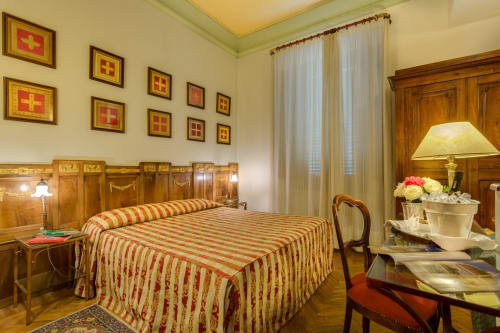
of the Crocetta after the small red cross that the nuns
wore sewn on their habit. Even the street was
called Via della Crocetta for a long period of time.
Along
this same street, in 1502 canon Marco Strozzi founded
another convent for six devout ladies: S. Maria degli
Angeli, afterwards called S. Maria degli Angiolini, near
the Palazzo of the Crocetta that later became the
Archeological Museum.
|
|
On
our side of the street, where the Hotel Morandi alla
Crocetta now stands, the convent of the Crocetta had its
gardens and cloisters. On this site, Sister
Domenica of Paradise had a vision of Jesus commemorated by
a XVI century tabernacle built to the rear, on Via Giusti.
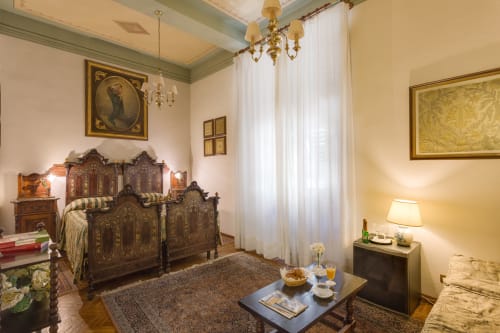
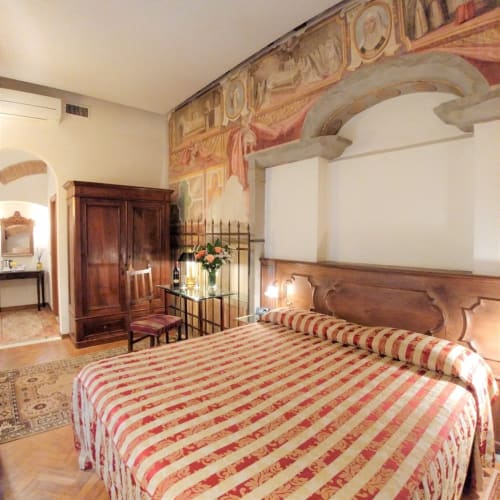
In the hotel Morandi alla Crocetta, one can admire XVII
century frescoes depicting scenes of the life of the
blessed Domenica of Paradise.
The
convent was then enlarged by the devout princess Maria
Maddalena de’Medici, daughter of Grand Duke Ferdinand I.
She lived in her Palazzo of the Crocetta, built in
1619, and, in order to visit the nuns more conveniently,
she had an overpass built across the street, which can
still be seen in Via Laura. The same princess
engaged the architect Luigi Orlandi in 1757 to redecorate
and modernise the church which contained the remains of
the, by now, Blessed Domenica of Paradise.
|
|
At
the turn of the century, during the suppression of
monasteries, the Convent of the Crocetta was requisitioned
and after various wanderings, the nuns settled in Via
Aretina, transferring the remains of Blessed Domenica of
Paradise. The church was partly demolished and
embodied in the building where the school of law of the
University of Florence stands, having formerly
housed the general archives of finances when Florence was
the capital of Italy. During the same period, as
capital of Italy, in order to satisfy the immediate need
for housing for the State employees, the cloisters and
convent were walled up to create new lodgings.
The convent of S. Maria degli Angeli was transformed into
a Conservatory by the Lorain Grandukes who later built the
further overpass.
|
|

|
At
number 48 is the modern entrance of the above mentioned
university where the church of the Crocetta used to stand.
From number 50 to number 60 are the XIX century
facades which cover the cloisters and gardens of the old
convent. At number 64, where a XIX century door
opens to the present archives of Real Estate registers,
was the location of the famous school of acting founded
and directed by the actor and theatre historian Luigi
Rasi. Marino Moretti, a student of that school,
having become a poet and narrator, wrote about it in a
book called "Via Laura". Also his friend
and writer Aldo Palazzeschi has set one of his
“Novels” dedicated to “Sora Cecchina” in Via Laura. The writer Vasco Pratolini placed the final
scene of his Novel “Il quartiere”, with the
reconciliation of the two main characters Valerio and
Marina, at the corner with Borgo Pinti. Their son
will then be called Lorenzo.
In
the house at number 56 the famous Florentine short story
writer Bruno Cicognani lived and died. He wrote
about Via Laura in his “Viaggio nella vita”.
The
long wall across the streets hides the archaeological
museum gardens with its Etruscan tombs and Roman columns,
where Gabriele D’annunzio places his “sentimental”
initiation (Faville del Maglio).
|